Field Notes September 2026
Every morning I get on The Bunker and walk through what the market's doing. Once a month, I step back and tell you what actually happened and why it mattered.
September was the month when a lot of the things we'd spent the summer arguing about finally started coming out of the field.
Eventually, somebody has to turn a wheel.
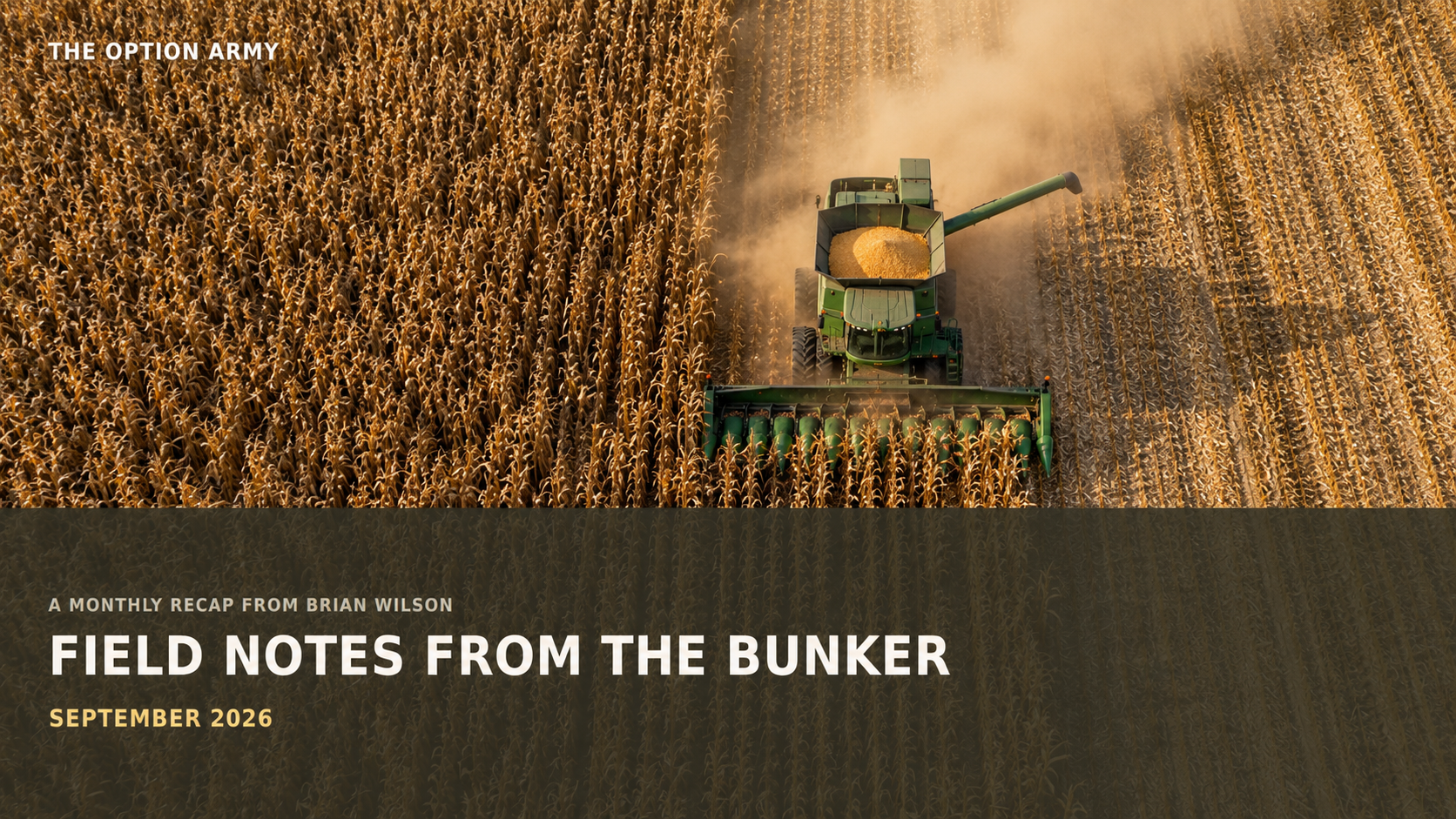
All summer we talked about crop ratings, weather maps, yield estimates, and what people were seeing from the road. September is when combines start replacing estimates with bushels.
And the first reports weren’t telling one clean story. We heard about disappointing beans and average corn in the Delta, disease and heat taking something off the top in Nebraska, and disappointing early yields in other areas. We also heard about really good crops in Illinois and reports of record crops in Tennessee and Kentucky. That’s harvest. You can drive 50 miles and hear two completely different stories.
A big crop and a good crop aren’t necessarily the same thing.
One of the questions that came up in The Bunker was whether farmer yield reports are biased. Probably, to some degree — we're all human. Somebody can call a crop “bad” because it made 225 instead of the 245 they expected. That’s still a lot of corn.
That’s why context matters. A disappointing crop can still be a big crop. A record crop in one area doesn’t tell you what happened 200 miles away. And a national number has to somehow turn all of those individual fields into one estimate.
The closer we get to actual harvest, the clearer the information gets. It doesn't necessarily get simpler.
The crop has to go somewhere.
Once harvest starts, yield isn’t the only number that matters. We spent a lot of time this month talking about basis, storage, spreads, and where all those bushels physically have to move.
There were reports of river basis dropping while harvest pressure was building, but also areas where soybean supplies could get tight because processors and the Pacific Northwest would be competing for the same beans. In the Delta, we heard about chicken feeders potentially having to reach farther for corn. Those aren’t contradictions. They’re reminders that a national balance sheet and a local cash market are two different things.
You can have plenty of grain nationally and still have a local market where supply and demand look very different.
Demand kept showing up while everybody watched supply.
Harvest naturally puts everybody’s attention on how much we're producing. But September kept giving us reasons to watch the other side of the balance sheet too.
Export sales kept coming across the screen, including repeated soybean sales to China and corn business to Mexico. At the same time, we were talking about domestic demand from livestock, processors, and renewable fuels.
Then late in the month, fund positioning became part of the conversation again. I made the point in the Bunker that funds don't have to suddenly turn bearish to move a market. When a large long position starts getting reduced, that alone can create selling pressure. The next question is just as important: who’s on the other side? Commercials, end users, and shorts all become part of that equation.
That’s an important habit in these markets that we build in The Bunker. Supply gets the headline during harvest because you can see the combines moving. But the crop coming out of the field is only one side of the market.
It’s useful when everybody doesn't agree.
One of the better discussions in The Bunker this month started with a simple observation: it’s a good thing we don't always agree.
Exactly.
There were plenty of mornings this month when Jason and I — or somebody in the chat — looked at the same market and didn’t see it the same way. That’s not a problem we’re trying to eliminate. It’s part of the exercise.
Risk management requires being able to understand the other side of your own argument. If everybody in the room agrees with you, you haven’t necessarily learned anything. Sometimes the most useful question is the one that makes you explain why you might be wrong. One member put it pretty well: “Risk mgmt is both sides.”
What tied it together.
September started turning estimates into actual bushels, but it didn’t magically make the picture clear. Some crops disappointed. Some surprised to the upside. Basis told one story in one part of the country and another somewhere else. Demand kept moving underneath all of it, and the market still had to decide what all that information was worth.
We got another reminder of that late in the month. Markets don’t just react to news — they react to what was expected before the news arrived. Sometimes the number matters. Sometimes the bigger question is whether the market had already priced in something better or worse.
None of this is a call to do anything. It’s why we keep looking at the whole picture every morning instead of waiting for one report, one yield, or one headline to tell us what the market means.
The combine gives you better information than the crop tour. It still doesn't give you the whole answer.
One more thing: Our live Intermediate Course: Options Applications starts on October 3, and there’s still time to join us. We’ll spend five Saturdays stepping beyond the basics and working through how these concepts actually fit together in real market situations. Learn more and register here.
See you next month.
Brian
If you found this useful:
Follow Brian on X/Twitter: @Badgerswimr — market context like this, every weekday morning.
The Bunker is Brian's daily live session — market walk-through, Q&A, and the Option Ranges tool, every weekday morning. Check it out here: The Bunker
Questions? Email us anytime at support@theoptionarmy.com.